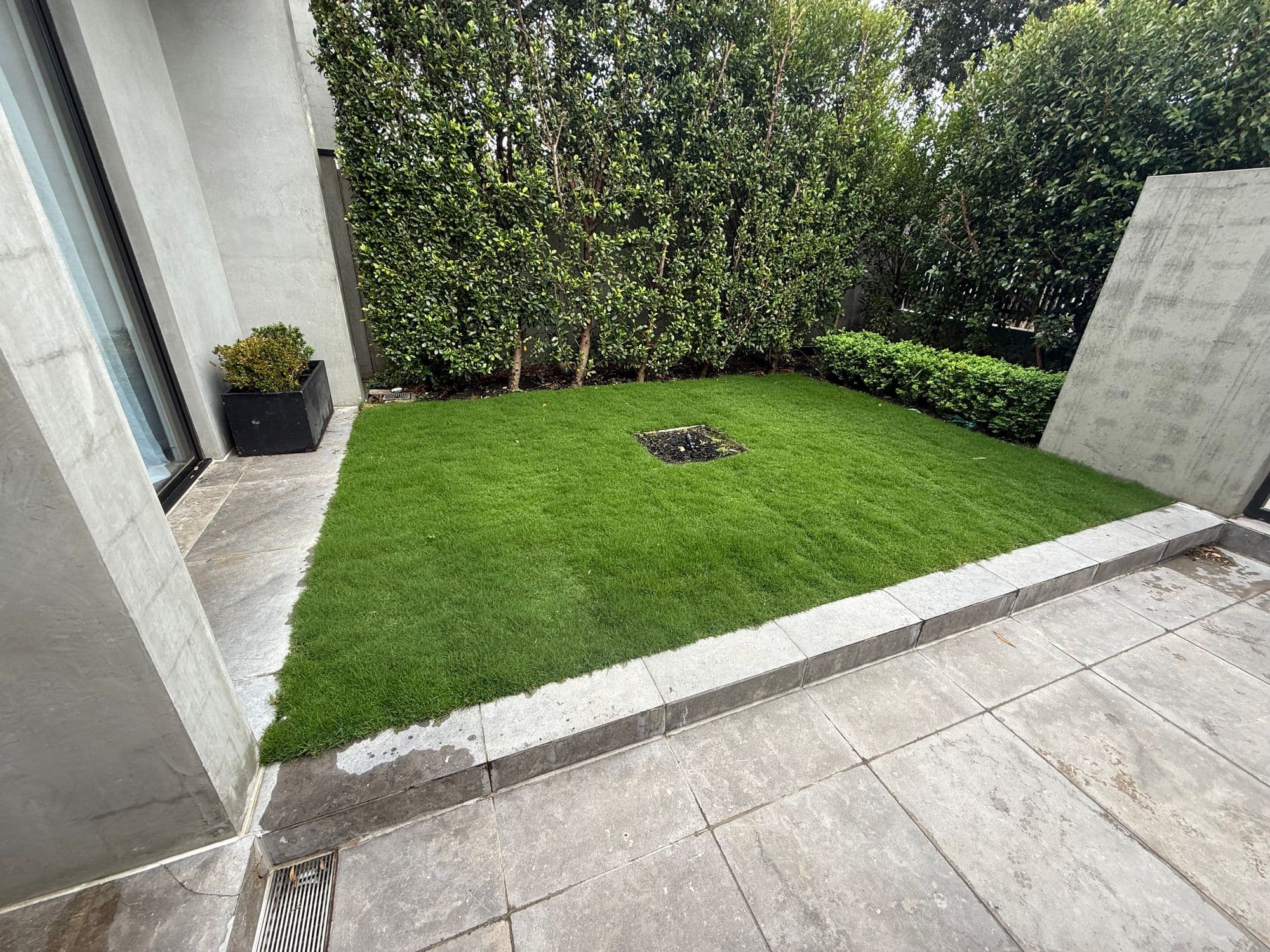
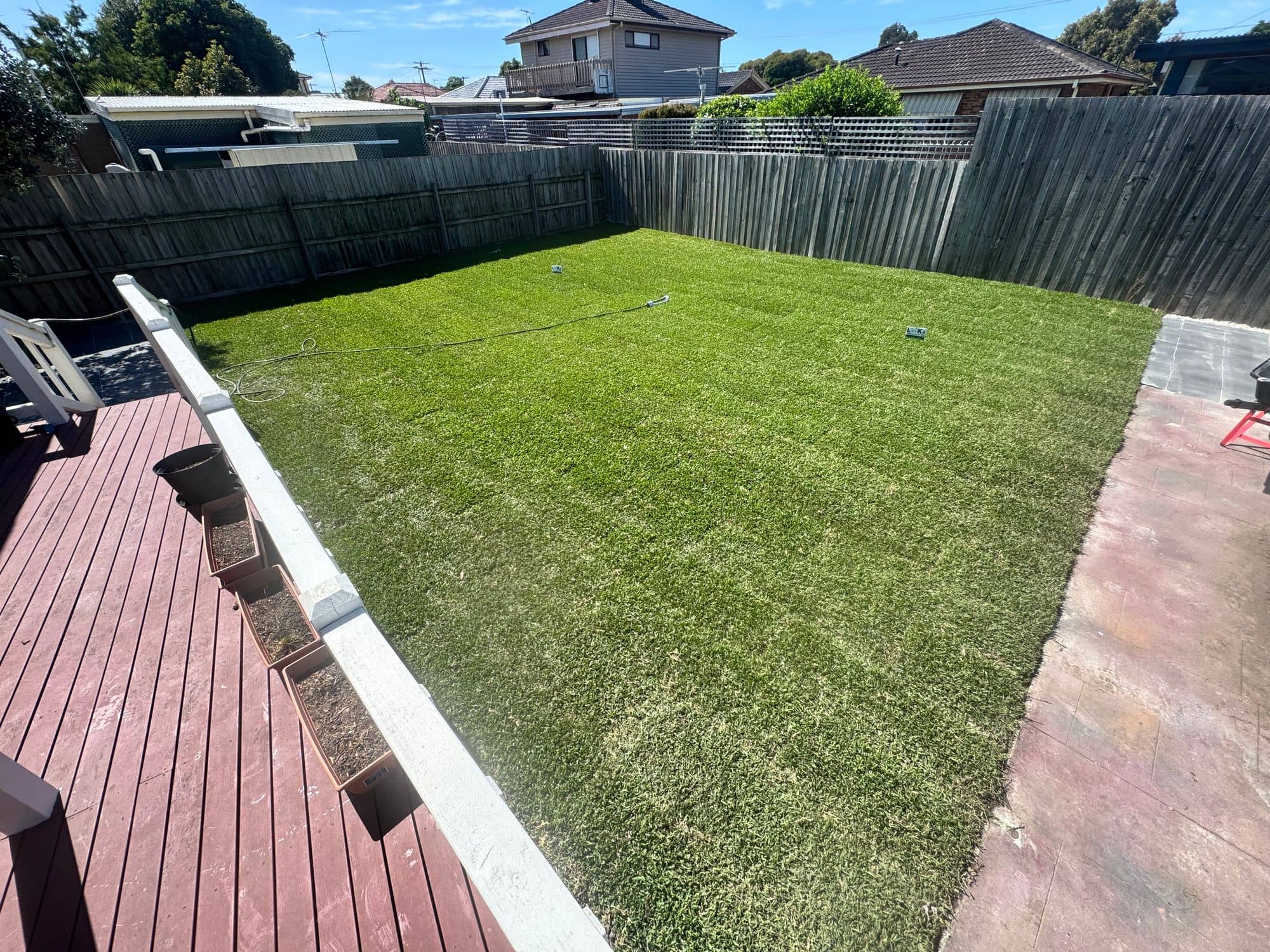
I'm Michael, owner of Regal Landscaping. We've laid over 12,500 square metres of turf across south-east Melbourne since 2013, and we've been called out to look at a lot of yellow lawns. Here's how I actually diagnose one, in the order I check things on site.
First, work out which yellow you've got
The pattern of the yellowing tells you most of the story before you even kneel down.
| What it looks like | Most likely cause |
|---|---|
| Whole lawn fading evenly in late autumn or winter | Dormancy. Normal, free to fix, see below |
| Yellow and limp, soil stays soggy | Overwatering or drainage |
| Straw-coloured, footprints stay flat in the grass | Not enough water |
| Pale all over, older leaves first | Hungry lawn, usually nitrogen |
| Yellow patches with a dark green ring | Dog urine |
| Patches that lift up like carpet | Lawn grubs eating the roots |
| Yellow stripes or arcs in a lawn with sprinklers | Irrigation coverage fault |
| Yellow tips a day or two after mowing | Blunt mower blades or cutting too low |
| One stubborn area that never improves, year round | Something under the lawn: shallow soil, compaction, or worse |
Now the causes, in the order worth checking.
1. Is your grass dying or just dormant? It might be winter
Almost every lawn in Melbourne is a warm-season grass: Sir Walter Buffalo, couch or kikuyu. When soil temperatures drop in winter, these grasses slow right down and lose colour. Buffalo holds its green better than couch or kikuyu, but even a healthy buffalo lawn will look paler and tired through July.
If your whole lawn faded gradually as the weather cooled, and it greened up fine last spring, that's dormancy. It is not dying. Mow less, stay off it when it's frosty, and it will come back when the soil warms up around October.
This is the one yellow lawn problem where the right answer is to do nothing. Anyone who quotes you to "fix" a dormant lawn in June is charging you for spring.
2. Watering: the number one lawn killer we see
Here's my honest take after more than a decade of laying turf: new lawns don't fail because of the turf. They fail because of the watering. We've seen brand-new lawns die exactly this way. Nobody is given the watering job, the lawn gets left, and a dead lawn turns into a weed bed.
Not enough water turns grass a dry straw colour. The quickest check: walk across it. If your footprints stay flat instead of springing back, it's thirsty.
Established Melbourne lawns want a deep soak once or twice a week, early morning, rather than a light sprinkle every day. Deep and rare grows deep roots. Shallow and often grows a lawn that panics every hot week.
Too much water also turns grass yellow, which surprises people. Waterlogged soil suffocates the roots. The lawn goes yellow and limp, the soil smells sour, and moss or mushrooms start appearing. If that's happening after heavy rain, the real problem is drainage or compaction, not the rain.
New turf is its own rule: water every day for the first two to three weeks, then taper off. Those first few weeks decide whether you have a lawn or an expensive weed mat.
3. A hungry lawn goes pale, not patchy
If the whole lawn has slowly gone a washed-out yellow-green, it's usually short on nitrogen. Grass is a hungry plant. Feed it a balanced lawn fertiliser each season, water it in properly, and follow the rates on the bag.
Two feeding traps worth knowing:
- Fertiliser burn. Too much fertiliser, or overlapping your spreader runs, scorches yellow stripes and patches into the lawn within days. Water heavily to flush the salts and let it grow out.
- Iron deficiency. If new growth is yellow while the veins in the leaf stay green, that's iron, not nitrogen. It's common on alkaline soils. An iron supplement greens it up quickly.
4. Your mower might be doing the damage
Two mowing habits turn lawns yellow. Blunt blades tear the grass instead of cutting it, and the shredded tips dry out yellow-white within a day or two. Sharpen the blades once a season at minimum.
The second is scalping: cutting too low, especially on bumpy ground. Never take more than a third of the leaf off in one mow. If the lawn looks yellow-brown immediately after you mow, raise the deck.
5. The dog
A yellow patch with a lush dark-green ring around it is dog urine. The nitrogen burns the centre and feeds the edges. If you can, follow the dog out and tip a bucket of water on the spot. Diluted straight away, it usually does no harm at all.
6. Sudden yellow patches mean grubs or fungus
If yellow patches appeared fast and the grass in them pulls up easily, like lifting carpet, the roots have been eaten. In Melbourne that's usually lawn grubs, African black beetle larvae or armyworm. Birds suddenly taking a keen interest in your lawn is another giveaway. A grub treatment from any garden centre sorts most cases if you catch it early.
Fungal disease turns up after warm, damp stretches, in Melbourne that's usually late summer into autumn. Lawn rust is the one we see most, and it has the easiest test going: walk the lawn and check your shoes. Orange dust means rust. Mow regularly, water in the morning only, and most of it clears on its own. A stubborn patch needs a fungicide.
7. The cause nobody checks: what's under your lawn
Most guides skip this one, and it's a job I'll never forget. A client called us about a lawn in terrible condition. They wanted it redone properly, with irrigation. When we dug up the old lawn, we found the entire lawn area was sitting on a concrete slab, with about 30mm of soil on top.
Grass needs at least 100mm of soil to root into. That lawn had spent its whole life living on three centimetres. It never had a chance.
It sounds extreme, but some version of this is common, especially in newer estates where builders bury rubble and leave skim coats of topsoil over compacted clay. If one area of your lawn stays yellow year after year no matter what you feed it, get a shovel and have a look. If you hit concrete, rubble or solid clay a few centimetres down, the fix is more soil, not more fertiliser.
Compacted soil is the milder version of the same problem. If a screwdriver won't push into the ground easily, roots and water can't get in either. Aerating with a fork or a coring machine opens it back up.
8. Yellow stripes or arcs? Check your sprinklers
If you have an irrigation system and the yellowing follows a pattern, dry arcs, strips or one corner that always struggles, the lawn is telling you exactly where the system has a fault. Blocked nozzles, a misaligned head, a leak or low pressure all leave their signature in the grass.
Run each zone and watch where the water actually lands. You're looking for head-to-head coverage, where every sprinkler throws far enough to reach its neighbour. If a zone looks weak or a head isn't popping up properly, an irrigation repair service can usually sort it in a single visit.
When a yellow lawn needs a professional, and when it doesn't
Don't call anyone if the whole lawn faded going into winter. That's dormancy and it's free.
Have a go yourself if it's watering, feeding, mowing or the dog. Those fixes cost little and work fast.
Call a professional when the same area fails every year no matter what you do, when you've found rubble or concrete under thin soil, when drainage is making parts of the lawn a swamp, or when you want the whole thing stripped and done properly with the right soil depth under it. That's the work we do every week across south-east Melbourne. Give us a call and we'll tell you straight which kind of problem you've got, even if the answer is "it's winter, mate, save your money".
Yellow lawn questions, answered straight
Can yellow grass turn green again?
Usually, yes. If the blades are yellow but the base and roots hold firm when you tug, the lawn is stressed, not dead, and it will revive once you fix the cause. If it pulls up with no resistance and the roots are gone, that section is dead and needs returfing.
How do I fix yellow grass fast?
Match the fix to the cause: a thirsty lawn gets a deep soak, a hungry lawn gets seasonal fertiliser watered in, dog patches get flushed straight away, and grubs get treated early. There's no one product that fixes all yellow lawns, whatever the bottle says.
Does overwatering turn grass yellow?
Yes. Waterlogged roots can't breathe, and the lawn goes yellow and limp. If the soil stays soggy a day after watering, water less and look at drainage.
Why is my grass yellow in winter?
Melbourne lawns are warm-season grasses that go semi-dormant in the cold. The colour fade is normal and reverses in spring. Don't fertilise heavily in winter to force the green, the lawn can't use it.
Why is my buffalo grass turning yellow?
Buffalo holds its colour better than couch or kikuyu, so a yellowing buffalo lawn usually points to dormancy, a hungry lawn, or a soil problem underneath. Check the table at the top and start with the season. If it's mid-winter, it's almost certainly dormancy.
Will Epsom salts fix a yellow lawn?
Almost never. They only help if the lawn is short on magnesium, which is rare. The real cause is usually watering, nitrogen, or one of the problems above. Diagnose first, then treat.
Is yellow grass dead?
Do the tug test. Firm resistance means alive and fixable. Lifts like loose carpet means the roots are gone, and that patch won't come back on its own.
Michael owns Regal Landscaping, a family-run crew working across south-east Melbourne, and still does every site visit himself.