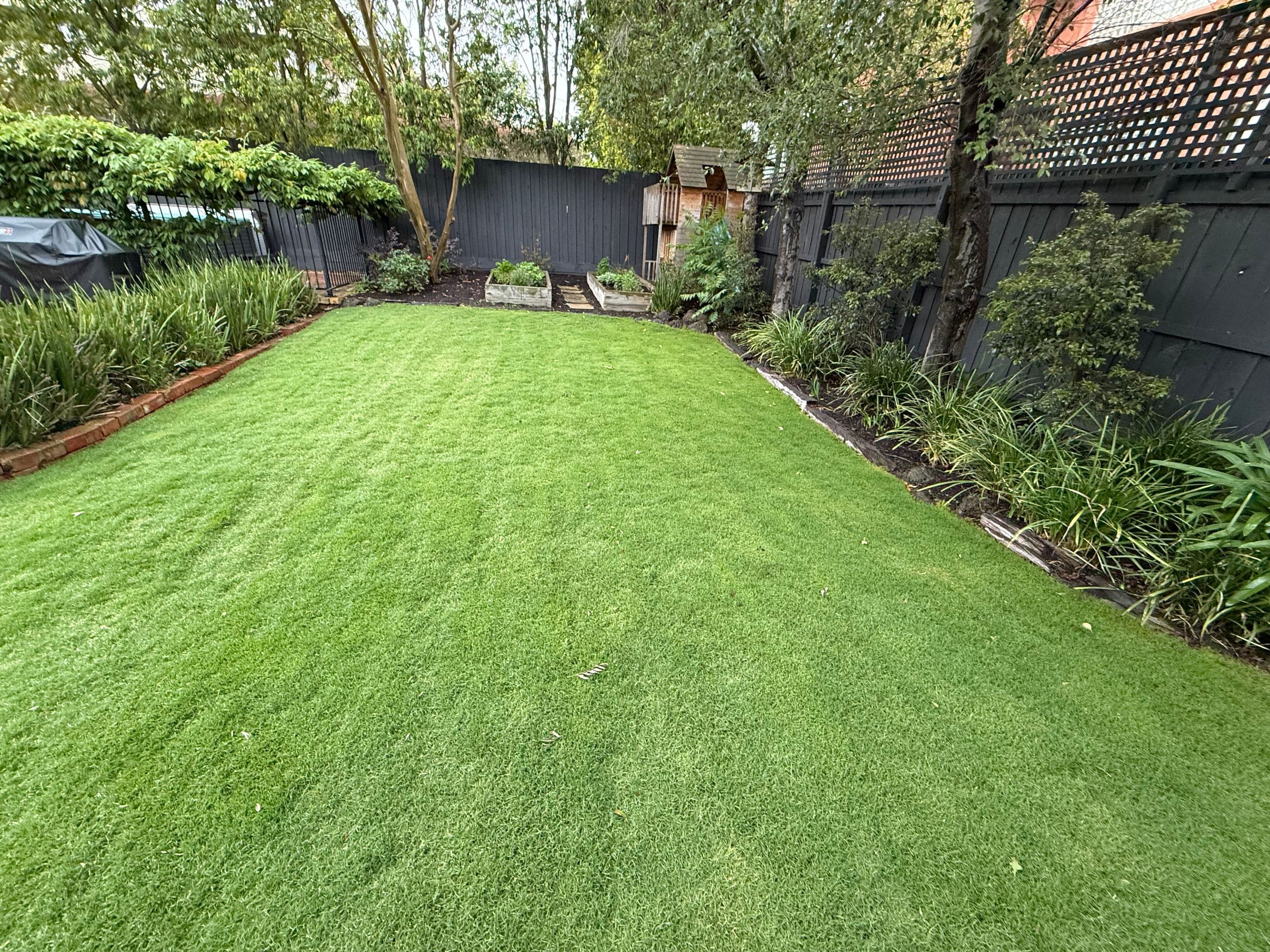
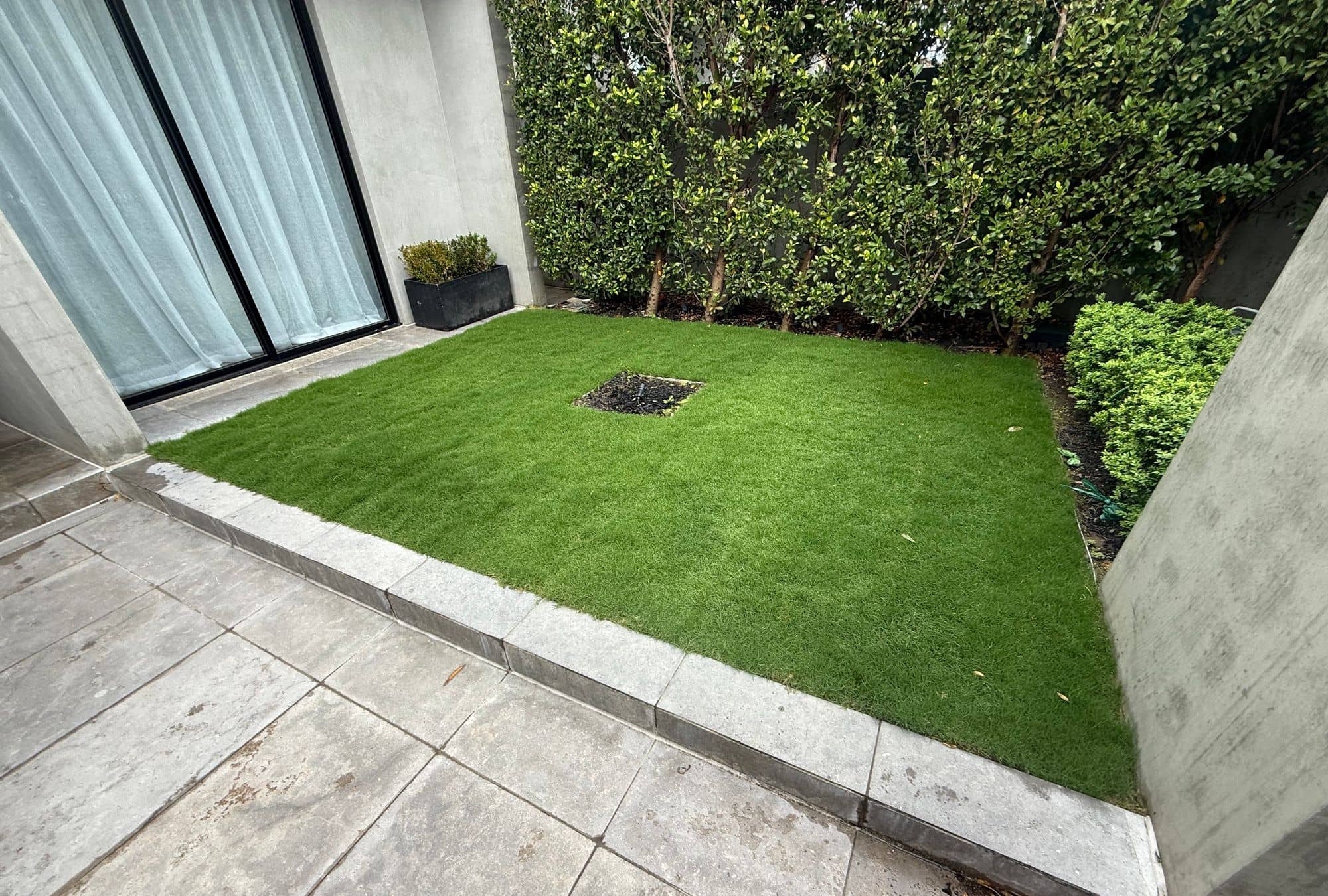
I'm Michael from Regal Landscaping. Brown patches are one of the most common reasons people send us photos of a lawn, and after more than a decade laying and fixing turf across Melbourne's south-east, I can usually pick the cause before I'm out of the ute. Here's the order I check things in.
Read the patch before you touch anything
Shape, edge and feel narrow it down to two or three suspects before you spend a cent.
| What the patch looks like | Most likely cause |
|---|---|
| Roughly circular, spreading, sometimes a darker ring around the edge, shows up in warm muggy weather | Fungal disease (brown patch or dollar spot) |
| Grass pulls up easily like loose carpet, birds digging at the lawn | Lawn grubs eating the roots |
| Small defined patch with a ring of extra-green grass around it | Dog urine |
| Patch feels dry and stays dry even after watering | Water-repellent or compacted soil |
| Stripes or patches that appeared within days of feeding the lawn | Fertiliser burn |
| Brown straight after mowing, especially on high spots | Scalping |
| Same patch browns off every summer no matter what you do | Shallow soil or something buried underneath |
Two free tests settle it in ten minutes
The tug test. Grab a handful of grass in the brown patch and pull. If it holds firm, the roots are alive and the grass can recover once you fix the cause. If it lifts like a piece of loose carpet, the roots are gone, and that usually means grubs.
The soapy water test. Mix a good squirt of dishwashing liquid into a bucket of water and pour it over the edge of the patch, where brown meets green. Wait ten minutes. If curl grubs or armyworm are in the soil, the soap irritates them and they come to the surface where you can see them. No grubs surfacing and firm roots means you're looking at a watering, soil or disease problem instead.
1. Grubs: dead patches with no roots left
In Melbourne the usual suspects are curl grubs (African black beetle larvae) and armyworm. They eat the roots, so the lawn starts dying in expanding patches that come away with no resistance. When the magpies and ibis start tearing at the same spot every morning, they've found the grubs before you have.
If the soapy water test brings them up, treat the lawn with a grub insecticide from any garden centre, water it in well, and do the whole lawn rather than just the patch. Grubs don't respect the borders of the brown bit. Catch them early and the lawn usually recovers. Leave them a month and you can lose the lot, roots and all.
2. Fungal disease: circles that grow in muggy weather
Brown patch is an actual disease, not just a description. It shows up as circular brown areas, sometimes with a darker smoky ring at the edge, and it thrives in sticky February and March weather. Buffalo lawns cop it more than most, so a fair share of the worried photos we get in autumn are buffalo.
The cure is mostly about water timing. Water in the morning only, never at night, so the leaf dries out during the day. Mow regularly, go easy on nitrogen in humid weather, and most fungal patches stop spreading and grow out on their own. A stubborn case needs a lawn fungicide, once, applied as the label says.
3. The dog did it
If you've got a dog, check this one first. The patch sits where the dog squats: brown in the middle, with a ring of greener grass around it where the diluted nitrogen acts as fertiliser instead of burning. No test needed, the green ring is the signature.
A bucket of water over the spot straight after the dog goes stops most patches forming at all. Burns that have already set need the dead grass raked out and the spot patched.
4. Dry spots: soil that repels water
Sandy soils, common through Melbourne's bayside suburbs, can become water-repellent over time. The water beads and runs off instead of soaking in, so you get brown patches that stay bone dry underneath even while the sprinkler runs. Push a screwdriver into the patch: if the soil is dust-dry a few centimetres down after watering, this is your problem.
A soil wetting agent sorts it, watered in a couple of times a year. If the ground is also hard, fork or core the patch first so air and water can get back in. Deep, less frequent watering beats a daily sprinkle.
5. Fertiliser burn: stripes you put there yourself
Patches or stripes that showed up within days of fertilising are chemical burn, usually a heavy hand or doubled-up spreader runs. Drown the area for a few days to wash the fertiliser down past the roots, then leave it alone and it grows out. When feeding, follow the bag rate and walk even passes. More is not greener.
6. Scalping: the mower did it
If the brown appears right after mowing, especially on humps and high spots, the mower has cut into the stems below the leaf. Lift the cutting height a notch or two. The rule on every mower we run: leave at least two thirds of the leaf standing. Scalped patches green up again within a few weeks in the growing season.
7. The patch that comes back every year
If the same spot browns off every summer no matter what you feed it, stop treating the grass and look underneath it. Shallow soil over rock, builder's rubble or old concrete dries out first and starves the grass above it, and no product fixes that. We've dug up worse than you'd believe, the worst case is in our yellow lawn guide. The fix is opening the spot up, getting decent soil depth in, and patching the lawn properly.
Don't patch until the cause is fixed
Fix the cause first, or the new grass dies the same way.
For small patches: rake out the dead material, loosen the top few centimetres of soil, add a bag or two of decent topsoil, and either seed or plug a piece of matching turf. Keep it damp until it knits in.
For big areas, the maths changes. Once a third or more of the lawn is gone, we find patching costs more time and money than stripping the area, fixing the soil properly and laying fresh turf, and a returfed area actually matches itself. Returfing is our bread and butter across south-east Melbourne. Give us a call and you'll get a straight answer: repair, restart, or a bag of soil and a free afternoon of your own time.
Brown patch questions, answered straight
How do I fix dead patches in my lawn?
Fixing dead patches starts with the tug test. Grass that holds firm is stressed, not dead, so fix the cause and it recovers. Grass that comes away in your hand has lost its roots, so treat the cause (usually grubs), then reseed or returf that section.
How do I get rid of brown patches in my lawn?
There's no single product for this, whatever the bottle promises. Grubs need an insecticide, fungus needs a dry leaf overnight, urine and fertiliser burns just need flushing with water, and dry spots need a wetting agent. Start with the table at the top of this page.
Will brown patch fungus go away on its own?
Often, yes. When the humid weather passes and the leaf stays dry overnight, brown patch usually stops spreading and grows out. Help it along by watering mornings only. If it keeps spreading after that, use a lawn fungicide.
How do I treat brown patches in an Australian lawn?
The same diagnosis applies anywhere in Australia: test for grubs with soapy water, check the soil moisture, look at the patch shape. Garden centres carry grub treatments, fungicides and wetting agents. The skill is picking the right one instead of buying all three.
Why does my buffalo lawn get brown patches?
Buffalo is more prone to brown patch disease than couch or kikuyu, especially in humid weather, and its thick thatch holds moisture against the leaf overnight. Water mornings only and mow regularly. The upside: buffalo's runners knit patches back together well once the disease is sorted.
When should I give up and returf?
Our rule of thumb: once a third of the lawn is dead, returfing beats patching on both cost and looks. Fix the underlying problem first, then lay fresh turf on properly prepared soil.
Michael runs Regal Landscaping from Clayton South and still walks every job himself.