
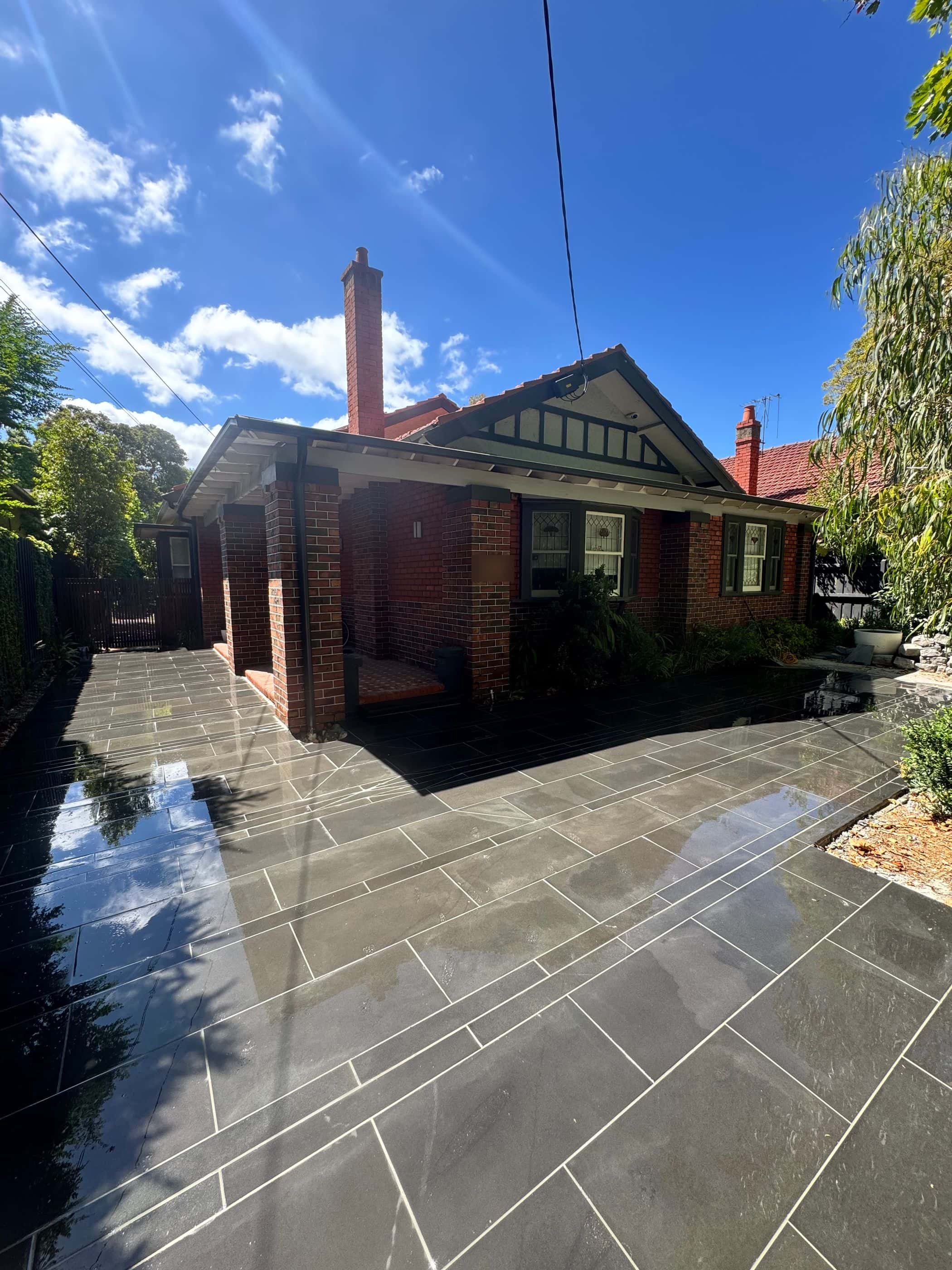
Landscaping in Caulfield, on sand and old garden bones
I'm Michael. I run Regal Landscaping from Clayton South, about 20 minutes' drive away, and we've been landscaping Melbourne's south east since 2013. In September 2026 we finished a front and back yard in Caulfield South, and we hold 5.0 stars from 60+ Google reviews. The site visit and the written quote are free. Give us a call on 0489 952 492 or send a few photos through the quote form.
What we build in Caulfield
Most Caulfield jobs are renovations rather than bare-dirt builds. A typical one takes in some of this:
- Lawns. Instant turf on a proper sandy loam bed: Sir Walter Buffalo where there's part shade, kikuyu where the yard gets full sun and takes a beating.
- Synthetic grass. For the back courtyard that never gets enough sun, or the yard where nobody wants to mow.
- Paving and paths. Bluestone, brick or pavers on a compacted crushed rock base, including recycled brick to suit an older house.
- Garden beds and planting. Beds rebuilt with plenty of organic matter, plus hedging and screening along the fence line.
- Irrigation. Drip line under the mulch and pop-ups on the lawn, on Hunter or Rainbird gear, with Daniel, our registered plumber, on the plumbing side.
Is Caulfield's soil sandy or clay?
Mostly sandy. Much of Caulfield sits on light, sandy ground that drains fast and lets nutrients wash straight through, the opposite of the heavy clay further east. So a new lawn or garden bed needs good soil and organic matter underneath it, and steady watering while it gets going.
You can read it in the local history. The standard history of the area is titled From Sand, Swamp and Heath, and Caulfield Park started out as Paddy's Swamp, where peat and sand were dug out in the 1860s and 1870s. Several other swampy, low-lying patches became parks as well.
On sand, the job is building the base up, not getting water out of it. The lawn goes onto a sandy loam underlay with a starter fertiliser, beds get compost dug right through, and irrigation does more of the work than it would on clay. A lawn that dries out or goes hungry soon turns yellow. The exception is the old low-lying ground, which can still sit wet after heavy rain, so I check the drainage at the site visit either way.
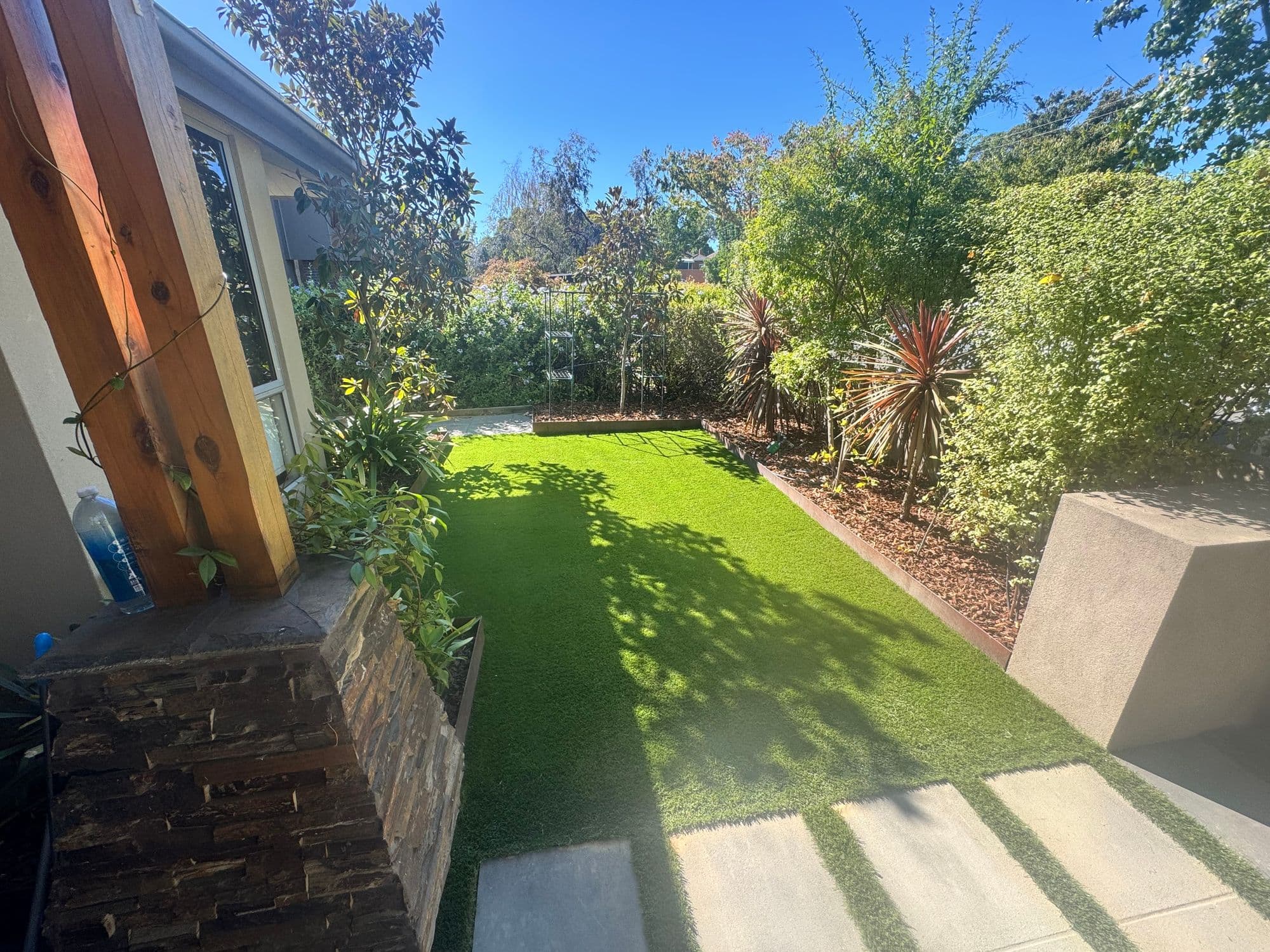
A finished Caulfield South job: kikuyu out the front, synthetic out the back
In September 2026 we finished a front and back yard in Caulfield South. Two surfaces, and two completely different bases under them, which is the part of a lawn job nobody ever sees. Here's what went into each.
| Step | Front yard: kikuyu turf | Back yard: synthetic turf |
|---|---|---|
| Strip-out | Old lawn and plants out, green waste carted away | Old surface and plants out, waste carted away |
| Dig depth | About 80mm, adjusted to the existing levels | 75 to 100mm, to fit a compacted base |
| Base | Sandy loam turf underlay, screeded so the fall runs away from the house, then a starter fertiliser | Crushed rock road base compacted in layers, a screeded sand bed, then weed mat |
| Surface | Fresh kikuyu laid the day it was delivered, in a staggered brick pattern with tight joins, then rolled | Classic 35 synthetic turf, seams taped and glued, edges pinned with galvanised nails |
| Finish | Watered in thoroughly on the day | Kiln-dried sand brushed in, then power broomed to stand the pile up |
The job was booked in for three days. Out the back, nearly all the work is in the compacted base, because synthetic turf only ever looks as flat as whatever sits under it.
Up in Caulfield North we've taken on a bigger garden: drip line to every bed, pop-up sprinklers on the lawns, a Rainbird tap timer running the zones, a new back lawn, and bluestone in a shady back corner where the old lawn had died off. The quote spells out that if we hit big tree roots digging that corner, we stop and talk it through rather than cut them.
Do I need a permit to remove or prune a tree in Caulfield?
Often, yes. Under Glen Eira's canopy tree local law, you need a council permit to remove or heavily prune a tree taller than 5 metres, or one with a trunk 140cm or more around, measured 140cm up from the ground. Palms count once they pass 8 metres. Check with council before anything gets cut.
Five metres catches plenty of ordinary garden trees, not just the giants. Minor pruning is fine once a year without a permit, as long as no more than 10 per cent of the canopy comes off and no branch is thicker than 10cm around where it joins the tree. Council also keeps a Classified Tree Register of its most valuable trees, on private land as well as public. And a state planning rule for canopy trees can apply on top, in which case council says the planning scheme prevails.
For us, it changes how we dig. Near a big tree we swap the machine for hand tools, run pipes and paving around the main roots, and stop to talk if we find something large, just like on the Caulfield North job. If a tree really does have to come out, getting the permit is the owner's job, and we wait for it.
Heritage overlays, period houses and front fences
Caulfield North is where the grand houses are. Glen Eira's own history of the area describes it as the fringe where the mansion estates went up, with a handful of houses from the 1850s and 1860s still standing and plenty of later Boom-era mansions and villas. Labassa, built around 1890, is the best known of them.
If your place is in a Heritage Overlay, council says a planning permit is generally needed to demolish or build a fence and to carry out works. So a new front fence, front path or paving out the front is worth checking before we price it. Some minor works, fences included, are exempt if they can't be seen from the street or a public park, and some heritage places carry tree controls too. You can look up your property on council's heritage overlay map or on VicPlan.
Old houses suit old materials. Recycled brick, bluestone and brick-edged lawn usually sit better in front of a period home than anything shiny. On one heritage brick job we laid a whole backyard using the client's own mix of old bricks, and this is how he put it:
The team did an excellent job of laying a consistent and level brick pattern using a whole range of old recycled bricks which varied in size and colour.
Heritage runs right through the suburb. Even Caulfield Racecourse, a Crown reserve since 1859, was added to the Victorian Heritage Register in February 2023, with its plantings and trees included.
How much does landscaping cost in Caulfield?
It depends on the size of the yard, the access and how much has to come out first. I price every job from a free site visit, with a written, itemised quote, so you can see exactly where the money goes.
| Job | What moves the price |
|---|---|
| Instant turf, laid | Removing the old lawn, how much underlay goes in, access down the side |
| Paving | Bluestone or recycled brick versus pavers, the number of cuts, the base |
| Synthetic turf | Base depth, the size of the area, edges and joins |
| Irrigation | Number of zones, drip or pop-ups, boring under paths |
| Garden beds and planting | Soil improvement, plant sizes, mulch |
You'll see labour, materials and waste as separate amounts on the quote, never one lump figure.
How a Caulfield job runs
- Give us a call on 0489 952 492, or send photos of the front and back through the quote form.
- I come out and walk it with you. On sandy ground I'm looking at the levels, low spots that hold water, the big trees, and whether the front is in a heritage area.
- You get a written, itemised quote, so you can see what each part costs.
- We book a start date and order the materials, so the turf turns up the day it gets laid.
- The build. Strip-out and base first, then paving and irrigation, with lawn and planting last.
- Handover. You get a watering plan for the new turf, every day for the first two to three weeks, and I check in once it has settled.
Get a quote for your Caulfield garden
Give us a call on 0489 952 492 or put a few photos through the quote form, and tell me what you want the garden to do. We've laid over 15,000 square metres of turf, we carry $5 million public liability insurance, and I quote every job myself. Nearby, you can read about our work in Bentleigh East and Glen Iris, or about instant turf in Bentleigh, and our base in Clayton South is about 20 minutes away. Every suburb we cover is on our service areas page.
Caulfield landscaping questions
How much does landscaping cost in Caulfield?
It comes down to the yard: the size, the access down the side and how much has to come out first. Synthetic turf, irrigation and planting depend even more on the site. I quote from a free site visit, with labour, materials and waste itemised, so nothing is a guess.
Do you work in Caulfield North, Caulfield South and Caulfield East?
Yes, all of them, and Caulfield itself. We finished a front and back yard in Caulfield South in September 2026 and have taken on a garden in Caulfield North. Our base is in Clayton South, about 20 minutes' drive away, and the site visit costs nothing.
Which lawn suits sandy soil, kikuyu or Sir Walter Buffalo?
Both grow well on sand once they have a decent underlay. Kikuyu loves full sun, recovers fast from wear and costs less to buy, but it runs into garden beds unless the edges are kept. Sir Walter Buffalo is softer and copes with part shade much better, so it suits gardens under established trees. I'll recommend one once I've seen how much sun the yard gets.
Can I put synthetic turf on my nature strip?
Not in Glen Eira. Council doesn't allow synthetic turf, pavers, rocks, sleepers or bare gravel on nature strips. You can plant one out with ground covers, low shrubs and grasses kept to 100cm or less, but you need a council permit first. The permit costs $50, and approved applicants get a $50 voucher for an indigenous nursery.
Our house is in a heritage overlay. Can we change the front fence and path?
Possibly, but check first. In a Glen Eira Heritage Overlay, building or demolishing a fence and carrying out works generally need a planning permit, and council notes that features like fences or paving can count as contributing elements in a heritage precinct. Look your property up on council's heritage map, then talk to council's planners. We'll price the work once you know what's allowed.
How long does a front and back yard take?
The Caulfield South job, a kikuyu lawn out the front and synthetic turf out the back, was booked in for three days. Bigger gardens with paving, irrigation and planting take longer, and rain can push things back. I'll give you the number of days with the quote and keep you posted if the weather moves it.
Does a lawn on sandy soil need more water?
It needs steadier water, especially at the start. Sand drains fast, so new turf dries out quicker than it would on clay. Water it every day for the first two to three weeks, then ease back. A good underlay holds more moisture, and a timer on drip line and pop-ups takes the guesswork out.
Other areas we cover
- Landscaping Oakleigh
- Landscaping Bentleigh East
- Landscaping Cheltenham
- Landscaping Camberwell
- Landscaping Kew
- Landscaping Clayton South
- Landscaping Glen Waverley
- Landscaping Mount Waverley
- Landscaping Glen Iris
- Landscaping Hampton
- Landscaping Carnegie
- Landscaping Bentleigh
- Landscaping Malvern East
- Landscaping Mulgrave
- Instant turf Bentleigh
- Instant turf Bentleigh East
- Instant turf Brighton East
- Instant turf Hampton
- Instant turf Hampton East
- All service areas
Get a free quote in Caulfield
Tell us a little about the job and we'll get back to you to book a time to measure up. Prefer to talk it through? Call Michael.